Focused Shockwave Therapy for Peroneal Tendinopathy
Peroneal tendinopathy refers to degenerative disorders affecting the peroneus longus and peroneus brevis tendons along the outer ankle. These tendons play an important role in ankle stability, balance, and foot eversion during walking, running, and cutting movements. Over time, repetitive stress, ankle instability, or mechanical overload can lead to collagen disorganization and a failed healing response within the tendon.
Chronic cases are most often degenerative (tendinosis) rather than inflammatory. Symptoms may include persistent lateral ankle pain, swelling behind the fibula, discomfort with resisted eversion, and, in some cases, snapping or instability if tendon subluxation is present.
For individuals in Memphis experiencing ongoing outer ankle pain, accurate diagnosis is essential to determine whether conservative management — including focused shockwave therapy — is appropriate or if structural instability requires further evaluation.
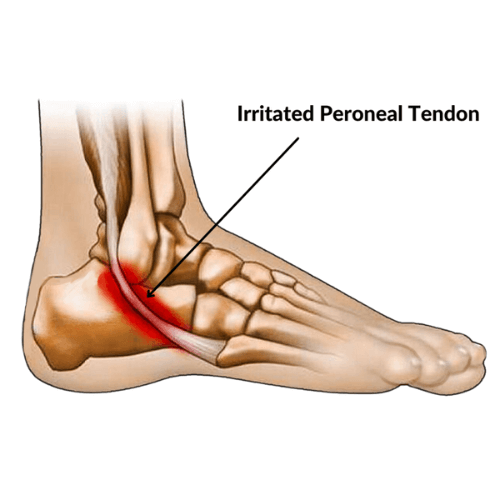
Does shockwave therapy help peroneal tendonitis?
Peroneal tendon disorders are most commonly described in clinical literature as degenerative tendinosis, particularly in long-standing cases. When major tearing or recurrent instability is not present, conservative management is typically recommended.
Extracorporeal shockwave therapy (ESWT) is used in musculoskeletal care as a nonoperative modality for degenerative tendon conditions. When structural integrity of the peroneal tendons is preserved, focused shockwave therapy may be incorporated into a broader conservative treatment strategy aimed at stimulating biological repair within degenerative tendon tissue.
Can shockwave therapy help tendinopathy?
Tendinopathy refers to degenerative changes within tendon tissue characterized by collagen disorganization and a failed healing response. Because chronic peroneal tendon disorders are often degenerative rather than inflammatory, management strategies aim to promote tendon remodeling.
Shockwave therapy is clinically categorized as a nonoperative modality used in tendinopathy management. It is typically integrated into structured rehabilitation programs that include progressive strengthening, proprioceptive retraining, and biomechanical correction rather than used in isolation.
What is the treatment for peroneal tendinopathy?
Treatment depends on severity, structural involvement, and ankle stability.
For tendinosis and mild tears without instability, conservative management is prioritized. This may include temporary activity modification, bracing when needed, structured strengthening of the peroneal muscles, and proprioceptive training to restore ankle control. In acute presentations, short-term immobilization may be appropriate.
When structural abnormalities such as recurrent tendon subluxation, significant longitudinal splits, or full-thickness tears are present and fail conservative care, surgical intervention may be required to restore mechanical stability.
Where should you not use shockwave therapy?
Shockwave therapy is not appropriate when significant structural instability, recurrent tendon subluxation, or major tendon tears requiring surgical repair are present. In such cases, conservative modalities alone cannot correct mechanical dysfunction.
A detailed clinical evaluation and, when necessary, imaging assessment are essential to determine whether nonoperative care is appropriate.
At Cole Pain Therapy Group in Memphis, evaluation of peroneal tendinopathy begins with a comprehensive assessment of ankle stability, tendon integrity, gait mechanics, and loading demands. The goal is to determine whether the condition is suitable for conservative management.
When structural instability or major tearing is not present, treatment focuses on progressive rehabilitation, peroneal strengthening, ankle stabilization, and movement retraining to improve load tolerance and reduce recurrence risk.
When appropriate for degenerative tendon conditions, focused shockwave therapy may be incorporated into a comprehensive rehabilitation plan. Patients from Memphis, Bartlett, Lakeland, and Arlington seek care for persistent lateral ankle pain when symptoms interfere with walking, running, or athletic performance.
Early evaluation and structured conservative care remain central to restoring tendon health and preventing progression to surgical intervention.
NEW PATIENTS
Step 1
Call today to schedule your convenient appointment.
Step 2
Pre-register your important health information on your phone or computer to save time.
Step 3
Meet your new doctor for a customized plan and start moving toward your goal!
Discover how we may help!
We are the Memphis area’s top-rated chiropractic group, providing you with gentle chiropractic care, dry needle therapy, exercise therapy, and therapeutic massage.

2845 Summer Oaks Dr, Memphis, TN 38134
(901) 377-2340
Life Shouldn't Hurt!
You Deserve To Feel Great. We Can Help!
Your go-to Chiropractor in Memphis, TN

Richard L. Cole, DC, DACNB, DAIPM, FIACN, FICC
Jeffrey D. Luebbe, DC, CCRD, CCSP
W. Steven Vollmer, DC, DAAPM
Bradford J. Cole, DC, MS, CSCS
J. Colby Poston, DC
Daniel H. Smith, DC
2845 Summer Oaks Dr., Memphis, TN 38134
(901) 377-2340
Monday – Friday:
8:00 AM – 6:00 PM
Saturday :
8:00 AM – 12:00 PM
Walk-ins are Welcome!
© 2025 Cole Pain Therapy Group, All Rights Reserved