Focused Shockwave Therapy for Psoas Tendinopathy
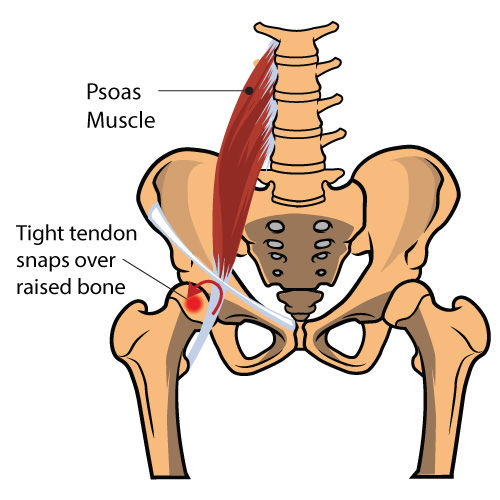
Psoas tendinopathy involves irritation or degeneration of the iliopsoas tendon, a powerful hip flexor connecting the psoas and iliacus muscles to the lesser trochanter of the femur. The iliopsoas originates from the lumbar spine and pelvis and plays an important role in hip flexion, external rotation, and stabilization of the lumbopelvic region. As the tendon travels across the front of the hip joint, it passes over several structures including the iliopsoas bursa and bony landmarks of the pelvis, making it susceptible to irritation during repetitive hip motion.
Psoas tendinopathy typically develops when repetitive hip flexion or excessive loading exceeds the tendon’s ability to recover. Over time, micro-trauma can lead to degenerative tendon changes rather than ongoing inflammation. This condition is often seen in athletes and active individuals who perform repetitive hip flexion movements, including runners, dancers, rowers, soccer players, and individuals involved in resistance training. Some patients may also experience internal snapping hip, where the iliopsoas tendon moves across bony structures of the hip and creates a snapping sensation.
Patients commonly report deep groin or anterior hip pain that worsens with activities such as running, climbing stairs, or rising from a seated position. Because chronic tendon disorders reflect degeneration rather than inflammation, treatment strategies focus on restoring tendon capacity and improving hip mechanics. For individuals in Memphis experiencing persistent hip flexor pain, Focused Shockwave Therapy may be incorporated into conservative treatment programs to help reduce pain and support tendon recovery.
Does shockwave therapy help the psoas muscle?
Shockwave therapy has been studied in the treatment of several chronic tendon disorders. The therapy delivers acoustic waves to targeted tissues, which may stimulate biological responses associated with tissue repair, circulation, and pain modulation.
Although research specifically evaluating the iliopsoas tendon is limited, shockwave therapy has demonstrated beneficial outcomes in other tendinopathies involving the shoulder, elbow, Achilles tendon, and plantar fascia. Because many tendon disorders share similar degenerative characteristics, shockwave therapy may be considered as part of a comprehensive treatment approach for chronic hip flexor tendon pain.
Is shockwave therapy good for tendinopathy?
Shockwave therapy has been widely researched in degenerative tendinopathies. These conditions develop when repetitive stress leads to micro-tearing and a failed healing response within the tendon.
Clinical studies show that extracorporeal shockwave therapy may help reduce pain and improve function in chronic tendon disorders such as Achilles tendinopathy, plantar fasciitis, calcific shoulder tendinitis, and elbow tendinopathies. Focused shockwave therapy is designed to deliver energy deeper into tissues, allowing clinicians to target areas of chronic tendon pathology more precisely.
How do you treat psoas tendinopathy?
Most cases of psoas tendinopathy are treated with conservative management aimed at reducing tendon overload and improving hip mechanics.
Treatment commonly includes activity modification, therapeutic exercise, and rehabilitation programs designed to improve flexibility and strength of the hip flexors and surrounding muscles. Manual therapy, myofascial release, and joint mobilization may help reduce muscle tightness and improve lumbopelvic mechanics.
Rehabilitation programs often focus on stretching tight hip flexors, strengthening hip stabilizers, and correcting biomechanical factors such as hip abductor weakness or altered gait patterns. In persistent cases, non-surgical treatments such as shockwave therapy may be integrated to support tendon recovery.
Where should you not use shockwave therapy?
Shockwave therapy is generally safe when performed by trained clinicians, but there are situations where it should not be used. Treatment is typically avoided over areas with active infection, tumors, open growth plates, or certain vascular and nerve structures.
Shockwave therapy is also avoided in patients with certain bleeding disorders or when treatment would involve the pelvic region during pregnancy. A thorough clinical evaluation is necessary to determine whether shockwave therapy is appropriate for each patient.
At Cole Pain Therapy Group in Memphis, psoas tendinopathy is evaluated through a detailed assessment of hip mobility, lumbopelvic stability, and movement patterns that contribute to hip flexor overload. Identifying the underlying causes of tendon stress allows treatment plans to address both pain and the mechanical factors driving the condition.
Treatment focuses on progressive strengthening of the hip flexors and surrounding stabilizing muscles, improving hip and core function, and correcting movement patterns that increase tendon loading. For patients with persistent hip flexor tendon pain, Focused Shockwave Therapy may be incorporated into a comprehensive non-surgical treatment plan to support tendon recovery and improve function for patients across Memphis, Bartlett, Lakeland, and Arlington.
NEW PATIENTS
Step 1
Call today to schedule your convenient appointment.
Step 2
Pre-register your important health information on your phone or computer to save time.
Step 3
Meet your new doctor for a customized plan and start moving toward your goal!
Discover how we may help!
We are the Memphis area’s top-rated chiropractic group, providing you with gentle chiropractic care, dry needle therapy, exercise therapy, and therapeutic massage.

2845 Summer Oaks Dr, Memphis, TN 38134
(901) 377-2340
Life Shouldn't Hurt!
You Deserve To Feel Great. We Can Help!
Your go-to Chiropractor in Memphis, TN

Richard L. Cole, DC, DACNB, DAIPM, FIACN, FICC
Jeffrey D. Luebbe, DC, CCRD, CCSP
W. Steven Vollmer, DC, DAAPM
Bradford J. Cole, DC, MS, CSCS
J. Colby Poston, DC
Daniel H. Smith, DC
2845 Summer Oaks Dr., Memphis, TN 38134
(901) 377-2340
Monday – Friday:
8:00 AM – 6:00 PM
Saturday :
8:00 AM – 12:00 PM
Walk-ins are Welcome!
© 2025 Cole Pain Therapy Group, All Rights Reserved