How to Overcome Psoas Tendinopathy and Relieve Hip Pain
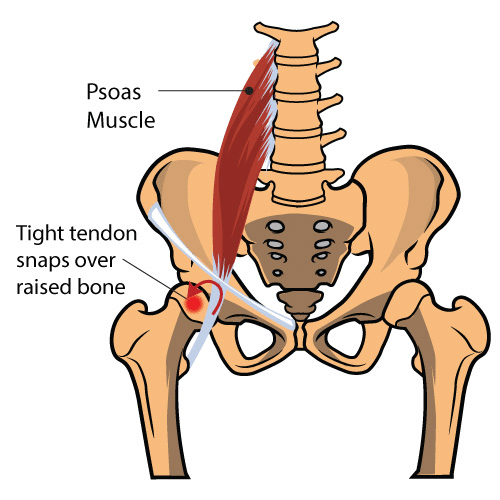
Psoas tendinopathy is a condition where the iliopsoas tendon — one of the main tendons at the front of your hip — becomes irritated or injured. This tendon is important for lifting your leg and rotating your hip outward.
Some people notice a “snapping hip” sensation when the tendon rubs over bones in the hip. If it’s painless, it may not be a problem. But when the snapping is painful, it can interfere with walking, sports, or even standing comfortably.
Because of its location, psoas tendon irritation is sometimes mistaken for other hip problems like Femoroacetabular Impingement (FAI) or even low back issues such as Thoracic Segmental Joint Dysfunction.
Why It Happens
The tendon can be irritated by either a sudden strain (like during a hard jump or kick) or from repetitive overuse. Athletes and dancers are especially at risk because of the demands placed on the hip flexors.
You may be more likely to develop it if you:
Dance (especially ballet), run, or play sports like soccer and gymnastics
Do repetitive hip movements, like rowing or hurdling
Sit for long periods, which shortens the hip flexors
Have muscle imbalances (such as weak glutes or abdominals)
Experience posture issues connected to leg length discrepancy or foot hyperpronation
This condition is sometimes called dancer’s hip or jumper’s hip, and it can also appear during growth spurts in teenagers when flexibility is reduced.
Symptoms of Psoas Tendinopathy
The most common complaint is deep groin pain, sometimes spreading to the front of the hip or thigh.
Other symptoms may include:
A snapping or popping sensation with hip movement
Pain with climbing stairs, running, or kicking
Trouble standing fully upright
Weakness or a limp from avoiding painful movements
Tenderness in the groin or front of the hip when pressed
Because of its close relationship to the lower back and pelvis, patients may also notice stiffness, muscle tightness, or related pain patterns that can mimic other conditions like Iliotibial Band Syndrome, Adductor Muscle Strain, or even foot-related issues like Morton’s Neuroma.
How It’s Diagnosed
A physical exam is usually enough to identify psoas tendon irritation. Your provider may:
Listen and feel for snapping during specific hip movements
Check for hip tightness with tests like the Thomas test
Look for weakness in hip flexion
Evaluate posture, stride length, and pelvic tilt
Imaging such as MRI or ultrasound is sometimes used if another issue is suspected, such as a SLAP lesion, labral tear, or hip arthritis.
Treatment Options
The good news: most patients improve with conservative (non-surgical) care.
Conservative Care
Activity modification – Take breaks from repetitive hip flexion (running uphill, deep lunges, or long sitting).
Stretching & strengthening – Gentle hip flexor stretches, core stability work, and exercises for glutes and rotators.
Manual therapy – Soft tissue release and myofascial work to reduce muscle tightness.
Postural corrections – Addressing issues like dysfunctional breathing, pelvic tilt, or foot mechanics. Orthotics or a heel lift may help if leg length discrepancy is contributing.
Cold therapy – Ice or gentle anti-inflammatory strategies for acute pain.
Medical Care
Corticosteroid injections may reduce inflammation in stubborn cases.
Surgery (tendon release) is rarely needed and only considered after other treatments fail.
With the right care, many patients feel better within weeks to months. Athletes and active individuals can return to play once hip strength and flexibility are restored. For those with chronic issues, making a New Year’s Resolution to focus on flexibility and core strength can help prevent recurrence.
NEW PATIENTS
Step 1
Call today to schedule your convenient appointment.
Step 2
Pre-register your important health information on your phone or computer to save time.
Step 3
Meet your new doctor for a customized plan and start moving toward your goal!
Discover how we may help!
We are the Memphis area’s top-rated chiropractic group, providing you with gentle chiropractic care, dry needle therapy, exercise therapy, and therapeutic massage.

2845 Summer Oaks Dr, Memphis, TN 38134
(901) 377-2340
Life Shouldn't Hurt!
You Deserve To Feel Great. We Can Help!
Your go-to Chiropractor in Memphis, TN

Richard L. Cole, DC, DACNB, DAIPM, FIACN, FICC
Jeffrey D. Luebbe, DC, CCRD, CCSP
W. Steven Vollmer, DC, DAAPM
Bradford J. Cole, DC, MS, CSCS
J. Colby Poston, DC
Daniel H. Smith, DC
2845 Summer Oaks Dr., Memphis, TN 38134
(901) 377-2340
Monday – Friday:
8:00 AM – 6:00 PM
Saturday :
8:00 AM – 12:00 PM
Walk-ins are Welcome!
© 2025 Cole Pain Therapy Group, All Rights Reserved