Focused Shockwave Therapy for Iliotibial Band Syndrome
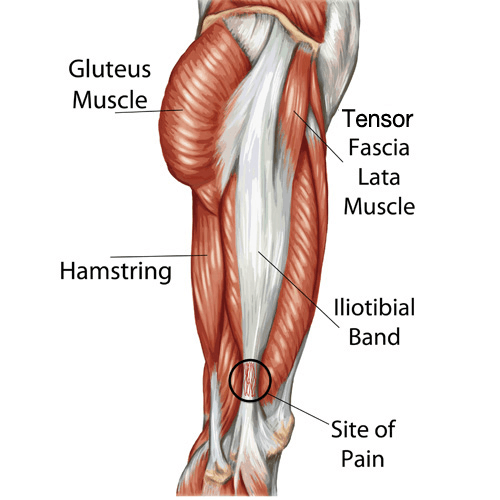
Iliotibial band syndrome (ITBS), sometimes referred to as iliotibial band friction syndrome, is a common overuse injury that causes pain along the outer side of the knee. It frequently affects runners, cyclists, and active individuals because these activities involve repetitive knee flexion and extension during single-leg stance. Pain typically develops near the lateral femoral condyle, approximately two centimeters above the outer knee joint line, and symptoms often worsen as activity continues.
The iliotibial band is a thick fibrous structure that runs along the outside of the thigh, connecting the tensor fascia lata and gluteus maximus muscles to the tibia at Gerdy’s tubercle. Current research suggests that IT band syndrome develops less from friction and more from compression of a highly innervated fat pad between the distal iliotibial band and the lateral femoral epicondyle during knee motion.
Several biomechanical factors can contribute to this compression. Weakness of the hip abductors may allow excessive thigh adduction and internal rotation during walking or running, increasing tension on the iliotibial band and stress at the outer knee. Because IT band syndrome is driven by mechanical overload and tissue irritation, treatment focuses on improving movement mechanics, strengthening the hip musculature, and reducing stress on the lateral knee.
For individuals with persistent symptoms, Focused Shockwave Therapy is increasingly used as a non-surgical treatment to support tissue recovery and improve pain associated with chronic iliotibial band syndrome.
Is shockwave good for IT Band Syndrome?
Shockwave therapy has been investigated as a treatment for iliotibial band syndrome, particularly in patients whose symptoms persist despite standard conservative care. Research suggests that shockwave therapy may help reduce pain and improve functional outcomes in individuals with chronic IT band irritation.
Focused shockwave therapy delivers targeted acoustic energy into affected tissues. This energy may stimulate circulation and biological repair responses within overloaded tissue. When combined with rehabilitation strategies such as hip strengthening and mobility work, shockwave therapy may support recovery from chronic iliotibial band syndrome.
What is the best treatment for iliotibial band syndrome?
Most cases of iliotibial band syndrome improve with conservative care. Treatment typically includes activity modification, stretching of the tensor fascia lata and surrounding hip structures, strengthening of the hip abductors, and addressing biomechanical factors such as running mechanics or muscle imbalances.
Hip abductor strengthening is one of the most important elements of rehabilitation. Research shows that individuals who incorporate targeted strengthening exercises for the gluteal muscles often experience significant improvement within several weeks. Additional therapies such as myofascial release, foam rolling, and focused shockwave therapy may be incorporated when symptoms persist.
What is focused shockwave therapy used for?
Focused shockwave therapy is a non-surgical treatment used in musculoskeletal care to address chronic pain and tissue overload. The therapy delivers concentrated acoustic waves to targeted tissues, which may stimulate circulation and activate biological healing responses.
Shockwave therapy is commonly used in the treatment of chronic tendon disorders and overuse injuries affecting areas such as the shoulder, elbow, hip, knee, and foot. In conditions like iliotibial band syndrome, it is typically combined with rehabilitation exercises designed to restore movement efficiency and reduce mechanical stress.
Can you walk after shockwave therapy?
Most patients are able to walk and continue normal daily activities after shockwave therapy. In many cases, only high-impact or symptom-provoking activities such as running may need to be temporarily modified while the tissue responds to treatment.
For conditions such as iliotibial band syndrome, shockwave therapy is usually incorporated into a structured rehabilitation plan. Activity levels are gradually progressed while strengthening and movement retraining address the biomechanical factors contributing to the injury.
Iliotibial band syndrome often develops because of underlying biomechanical stress rather than a single isolated injury. Weak hip abductors, altered running mechanics, muscle imbalances, and repetitive loading patterns can all increase tension through the iliotibial band and contribute to compression at the outer knee.
At Cole Pain Therapy Group, evaluation focuses on identifying the mechanical factors driving iliotibial band irritation. Treatment programs may include hip abductor strengthening, mobility work, movement retraining, and soft-tissue therapy to reduce mechanical stress on the lateral knee and restore proper lower-extremity function.
For patients experiencing persistent lateral knee pain, Focused Shockwave Therapy may be incorporated as part of a comprehensive non-surgical treatment plan. This therapy delivers targeted acoustic energy into affected tissues to stimulate circulation and support the body’s natural healing response. Patients from Memphis, Bartlett, Lakeland, and Arlington often seek care at Cole Pain Therapy Group to address chronic IT band pain and return safely to running, cycling, and other activities.
NEW PATIENTS
Step 1
Call today to schedule your convenient appointment.
Step 2
Pre-register your important health information on your phone or computer to save time.
Step 3
Meet your new doctor for a customized plan and start moving toward your goal!
Discover how we may help!
We are the Memphis area’s top-rated chiropractic group, providing you with gentle chiropractic care, dry needle therapy, exercise therapy, and therapeutic massage.

2845 Summer Oaks Dr, Memphis, TN 38134
(901) 377-2340
Life Shouldn't Hurt!
You Deserve To Feel Great. We Can Help!
Your go-to Chiropractor in Memphis, TN

Richard L. Cole, DC, DACNB, DAIPM, FIACN, FICC
Jeffrey D. Luebbe, DC, CCRD, CCSP
W. Steven Vollmer, DC, DAAPM
Bradford J. Cole, DC, MS, CSCS
J. Colby Poston, DC
Daniel H. Smith, DC
2845 Summer Oaks Dr., Memphis, TN 38134
(901) 377-2340
Monday – Friday:
8:00 AM – 6:00 PM
Saturday :
8:00 AM – 12:00 PM
Walk-ins are Welcome!
© 2025 Cole Pain Therapy Group, All Rights Reserved